A Landmark in Computer Vision
In 1981, Bruce D. Lucas and Takeo Kanade presented “An Iterative Image Registration Technique with an Application to Stereo Vision” at the International Joint Conference on Artificial Intelligence.
The research addressed a fundamental problem in computer vision: determining how corresponding regions in different images can be accurately aligned.
Lucas and Kanade proposed an iterative image-registration technique that uses spatial intensity information to progressively estimate this alignment. Instead of exhaustively testing a large number of possible matches, the method uses image gradients to guide the search toward an appropriate solution.
The work became the foundation of what is now widely known as the Lucas-Kanade method.
The Image Registration Problem
Image registration involves establishing spatial correspondence between two images.
This becomes important when the same scene is observed from different viewpoints or when visual information changes between frames. A computer-vision system needs to determine which parts of one image correspond to those in another.
Lucas and Kanade developed an approach designed to make this process computationally efficient.
Their method uses spatial intensity gradients and iterative refinement, reducing the need to independently evaluate every possible image displacement.
Application to Stereo Vision
The original research demonstrated the technique in the context of stereo vision.
Stereo vision uses images captured from different viewpoints to obtain information about the structure and depth of a scene. One of its central problems is correspondence: identifying where the same visual feature appears in each image.
The Lucas-Kanade approach provided a computational framework for addressing this registration problem.
Beyond Simple Translation
The research was not limited to basic horizontal or vertical image displacement.
The original work also considered more general image transformations, including rotation, scaling and shearing, demonstrating the broader potential of the registration framework.
This ability to formulate visual correspondence as an iterative computational problem helped make the approach relevant beyond its initial stereo-vision application.
The Lucas-Kanade Method
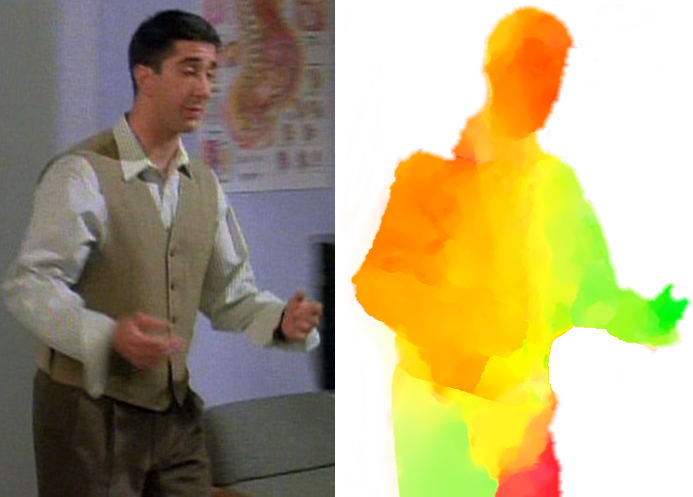
Over time, the technique became widely associated with optical flow, feature tracking and image alignment.
These problems are fundamental to computer vision because machines often need to understand how objects, visual features or cameras move between successive images.
The Lucas-Kanade method became one of the most recognizable contributions associated with Takeo Kanade’s early computer-vision research.
An Enduring Contribution
The 1981 publication reflects a broader theme that would continue throughout Kanade’s career: combining rigorous computational principles with visual-perception problems that can be demonstrated in working systems.
His subsequent research would extend across computer vision, robotics, autonomous systems, three-dimensional vision and visual technologies.
The Lucas-Kanade work remains an important early example of that approach.
Publication Details
Title: An Iterative Image Registration Technique with an Application to Stereo Vision
Authors: Bruce D. Lucas and Takeo Kanade
Year: 1981
Conference: 7th International Joint Conference on Artificial Intelligence (IJCAI)
Pages: 674–679
Research Area: Computer Vision, Image Registration, Stereo Vision