Seeing Three Dimensions from a Single Image
A photograph is fundamentally two-dimensional, yet people can often look at a single image and form a strong impression of the three-dimensional shapes represented within it.
For computer vision, reproducing this ability presents a fundamental challenge. A single two-dimensional projection does not uniquely determine the three-dimensional scene that produced it. Many different shapes can potentially result in the same image.
In his 1981 paper “Recovery of the Three-Dimensional Shape of an Object from a Single View,” Takeo Kanade investigated how assumptions about geometry, the physical world and image formation could be used to systematically recover three-dimensional shape from a single picture. Robotics Institute Publications
The Challenge of Shape Recovery
When humans interpret an image of a box, chair or other familiar structure, they naturally infer information that is not explicitly represented on the flat image plane.
A computer must instead determine what constraints allow a particular three-dimensional interpretation to be preferred over many other geometrically possible alternatives.
Kanade’s research focused primarily on identifying and exploiting geometrical assumptions that could make this inference computationally possible. Robotics Institute Publications
The Origami World
An important component of the method was Kanade’s Origami theory.
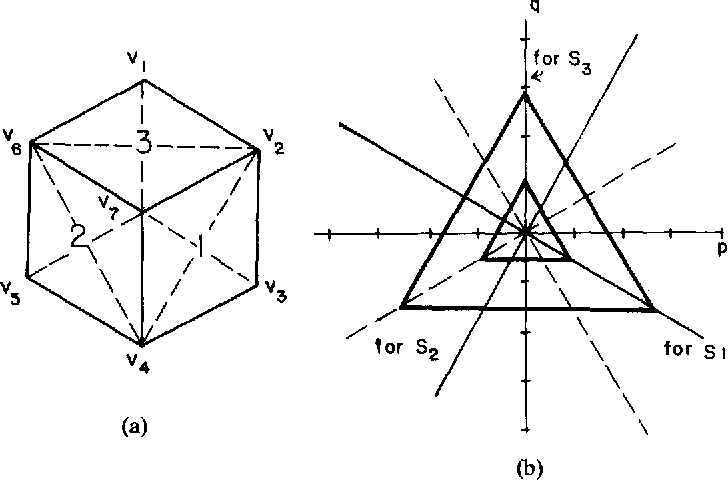
The Origami World models a scene as a collection of planar surfaces. Kanade’s approach first uses this representation to recover possible shapes qualitatively before applying additional image constraints to estimate probable shapes quantitatively. Robotics Institute Publications
This provided a structured way of reasoning from lines and surfaces visible in a two-dimensional image toward an interpretation of the underlying three-dimensional object.
From Image Regularities to Shape Constraints
The second major component of the approach involves translating regularities visible in an image into constraints on possible three-dimensional shapes.
Instead of treating visual properties simply as patterns in a flat picture, they can provide information about the geometry of the scene that generated the image.
Combined with the Origami representation, these constraints allowed the system to move from possible qualitative interpretations toward a probable quantitative reconstruction. Robotics Institute Publications
Demonstrating Shape Recovery
Kanade demonstrated the approach on objects including a box and a chair.
Starting from a single image, the method recovered a three-dimensional representation of the depicted object. The reconstructed model could then be used to generate images showing how that object would appear when viewed from other directions. Robotics Institute Publications
This demonstration captured one of the central ambitions of early computer vision: moving beyond recognition of patterns in an image toward an understanding of the three-dimensional world responsible for those patterns.
A Foundation for 3D Vision Research
Kanade’s research on single-view shape recovery was part of a broader investigation into computational approaches to three-dimensional scene interpretation.
His subsequent work continued to examine the relationship between image properties, geometry and three-dimensional scenes, contributing to a research direction that became fundamental to computer vision. CMU’s archive, for example, records his later invited paper addressing three levels of 3D scene interpretation: surfaces, volumetric objects and complete scenes. Robotics Institute Publications
The 1981 paper therefore represents an important stage in Kanade’s long-running work on enabling machines to reason about the physical world from visual information.
Publication Details
Title: Recovery of the Three-Dimensional Shape of an Object from a Single View
Author: Takeo Kanade
Year: 1981
Month: August
Journal: Artificial Intelligence
Volume: 17
Issue: 1
Pages: 409–460
Research Area: Computer Vision · 3D Vision · Shape Recovery Robotics Institute Publications